Sea turtles have lived in Earth's oceans for more than 100 million years. They survived enormous changes to the planet, including the extinction event that wiped out the dinosaurs.
Today, all seven species of sea turtles face human-caused threats, and pollution is one of the problems affecting the oceans they depend on. Sea turtle
🐢 A Sea Turtle's Entire Life Depends on a Healthy Ocean
A sea turtle may travel thousands of miles throughout its lifetime.
The ocean is where sea turtles find food, migrate, rest, grow, and spend the majority of their lives. Female sea turtles return to beaches to lay their eggs, and newly hatched turtles must make their way from the sand to the ocean.
Healthy oceans provide sea turtles with food and habitat.
But when plastic, discarded fishing gear, chemicals, oil, sewage, and other pollution enter the ocean, the environment turtles depend on begins to change.
🌊 What Happens When a Turtle Mistakes Trash for Food?
Sea turtles don't understand the difference between food and plastic.
A floating plastic bag can resemble a jellyfish.
Small pieces of plastic can become mixed with seaweed and other foods.
When a turtle swallows plastic, it can cause serious problems.
Plastic may block or damage the digestive system, interfere with normal feeding, contribute to malnutrition, and increase the risk of illness or death.
Even when plastic doesn't kill a turtle immediately, eating debris can reduce the amount of real food the turtle is able to consume.
🐢 What Happens When Turtles Become Tangled in Trash?
Not all ocean pollution is swallowed.
Discarded fishing line, nets, ropes, plastic packaging, and other debris can wrap around a turtle's body, neck, or flippers.
This is called entanglement.
Entangled turtles can suffer severe injuries, lose flippers, struggle to swim or feed, become unable to reach the surface to breathe, and drown.
Lost and abandoned fishing gear is especially dangerous because it can continue trapping marine animals long after people stop using it.
🌿 Dirty Oceans Can Affect a Turtle's Food
Pollution doesn't only affect the turtle.
It can damage the entire ecosystem.
Sea turtles eat different foods depending on their species. Their diets may include seagrasses, algae, jellyfish, sponges, crabs, and other marine organisms.
Pollution, poor water quality, and habitat damage can affect seagrass beds, coral reefs, and other important feeding areas.
When the ocean ecosystem becomes unhealthy, finding nutritious food and safe habitat can become more difficult.
🧪 Chemicals Can Move Through the Ocean Food Web
Some pollutants can persist in the environment and accumulate in marine organisms.
As animals eat contaminated food, certain pollutants can move through the food web.
Sea turtles can be exposed to contaminants through the water they live in and the food they eat.
Scientists study how these pollutants may affect turtle health, including their immune systems, development, and reproduction.
This is one reason keeping pollution out of waterways matters.
What enters a storm drain, river, or stream can eventually reach the ocean.
🏖️ The Problem Doesn't Stop at the Water
Trash on beaches can also create problems for sea turtles.
Female turtles need suitable beaches to build nests and lay their eggs.
Hatchlings need a relatively clear path to reach the ocean.
Plastic containers, fishing line, beach furniture, and other debris can become obstacles or entanglement hazards.
Artificial lighting near nesting beaches creates another serious problem.
Newly hatched turtles naturally use light cues from the horizon to find the ocean. Bright artificial lights can cause them to crawl in the wrong direction, increasing their risk of exhaustion, dehydration, predation, and death.
💔 A Turtle May Travel Thousands of Miles—But It Can't Escape Our Trash
This is perhaps the most important lesson.
There is no separate "away" where our garbage disappears.
A plastic item dropped on the ground can enter a storm drain.
The storm drain can carry it into a creek.
The creek can carry it into a river.
The river can carry it into the ocean.
Once there, some plastic debris can remain in the environment for a very long time, breaking into smaller and smaller pieces rather than simply disappearing.
Eventually, those pieces can become part of the environment where turtles and other wildlife live and feed.
🌎 What Can One Person Actually Do?
No single person can clean the entire ocean.
But every person can help prevent more waste from reaching it.
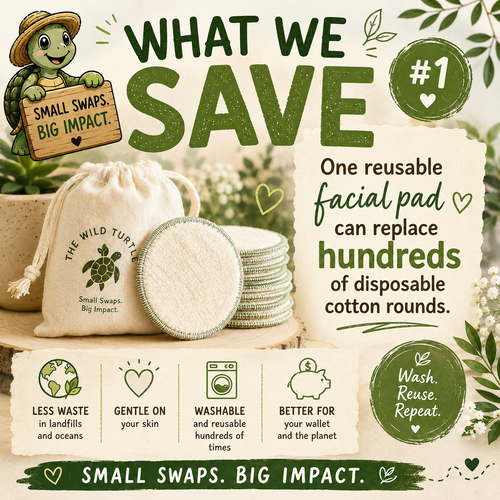
Use reusable products when they genuinely replace disposable ones.
Use the products you already own for as long as possible.
Avoid littering and secure outdoor trash so it doesn't blow into waterways.
Reduce unnecessary single-use plastics.
Participate in local beach, river, park, and neighborhood cleanups.
Dispose of fishing line and gear responsibly.
Choose products designed to be reused rather than immediately thrown away.
And teach children why protecting wildlife and waterways matters.
🐢 Why The Wild Turtle?
The turtle represents something important to us.
Sea turtles have traveled our oceans for millions of years.
They don't create plastic.
They don't choose polluted water.
They don't decide what gets thrown away.
But they live with the consequences of the choices people make.
That's why The Wild Turtle believes that small choices matter.
We won't pretend that buying one reusable product will save the ocean.
But replacing disposable products, using what we own longer, creating less unnecessary waste, and caring about where our trash ends up are meaningful steps toward a cleaner world.
Because the ocean isn't just water.
It's someone's home.
And every turtle deserves a cleaner place to live.
Small Swaps. Big Impact. 🐢🌊